
How common is gum disease?
Data from the US Centers for Disease Control and Prevention put some degree of periodontitis, the form that destroys bone, in nearly half of adults aged 30 and over. It rarely hurts until late.
When should I see a periodontist?
Your general dentist may refer you, or you can book with us directly, if you notice:
- Gums that bleed when you brush or floss, or are swollen and tender.
- Gums that have pulled back, so teeth look longer or roots are exposed and sensitive.
- New gaps between teeth, or teeth that have shifted or feel loose.
- Persistent bad breath, a bad taste, or pus between the gum and a tooth.
- A red, white or gray patch on the gum, which needs its own diagnosis.
What is the difference between gingivitis and periodontitis?
Gingivitis is inflammation of the gum only: red, swollen, bleeding, and reversible with professional cleaning and home care. Periodontitis follows when the inflammation reaches the ligament and bone. Lost bone does not grow back on its own; pockets (the space between gum and tooth, normally 1 to 3 mm deep) deepen, and teeth eventually loosen. Periodontitis is staged by how much support is lost and graded by how fast it progresses. The older term “periodontosis” is no longer used.
What does a periodontist actually do?
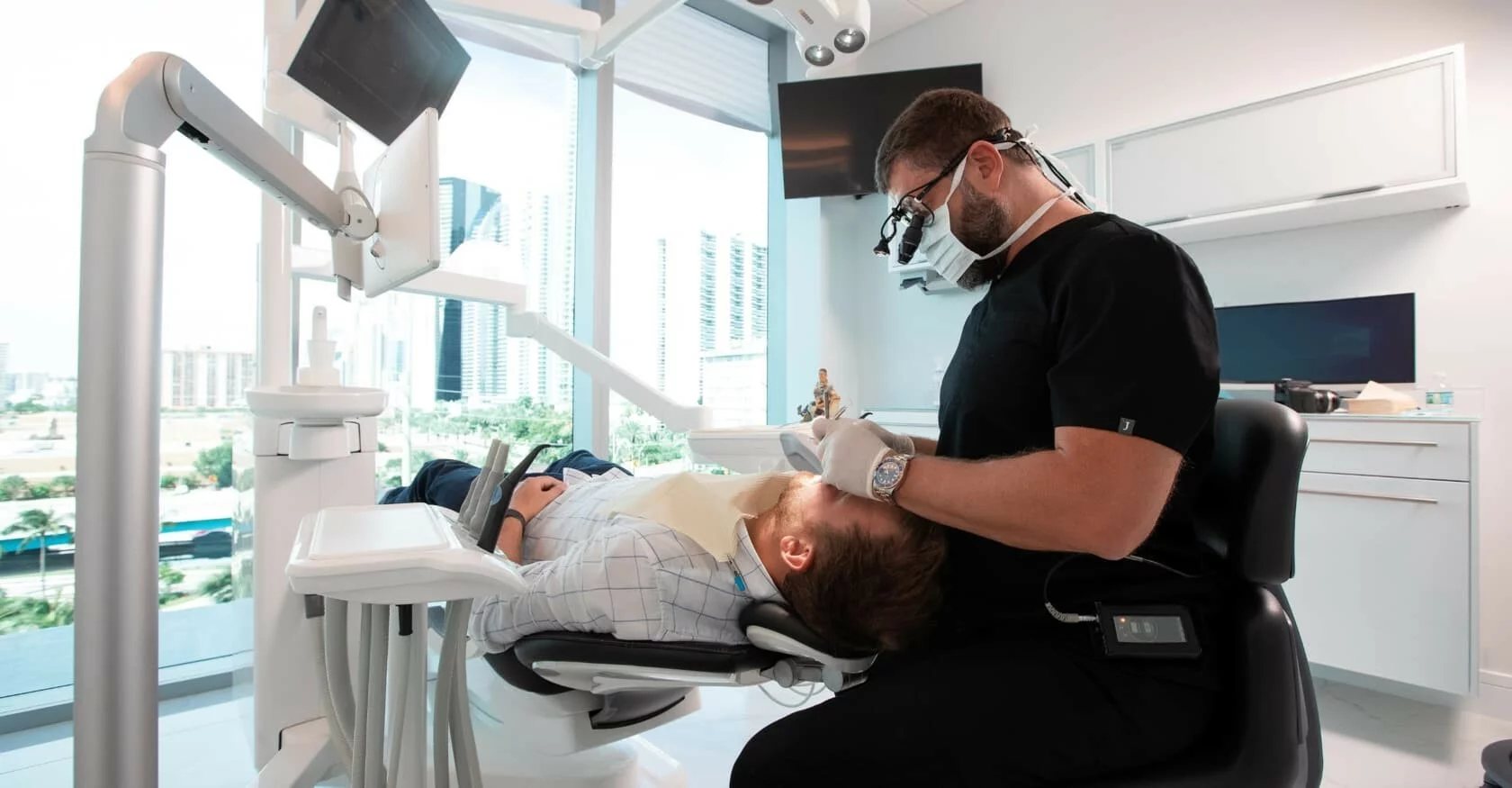
At our Sunny Isles Beach office, Dr. Tetri’s work falls into five groups:
- Non-surgical treatment. Scaling and root planing, often called deep cleaning: removing hardened deposits (calculus) from the root surfaces under the gum, with local anesthetic (deep cleaning at our office). We add Airflow polishing (a powder-and-water spray for stain and soft bacterial film) as a hygiene step, not a substitute.
- Periodontal surgery. When pockets stay deep after cleaning: flap surgery (folding the gum back to clean the roots directly), regenerative procedures that can rebuild some lost bone where the defect’s shape allows, and gum grafts to cover exposed roots or thicken thin tissue (periodontal care and surgery).
- Tooth extraction and site preservation. Removing a tooth that cannot be saved while protecting the socket, often with a graft, so an implant stays possible (tooth extraction). Teeth can be removed with ultrasonic surgical instruments that cut bone precisely.
- Bone grafting and sinus lift. Rebuilding the width or height of the jaw, or adding bone under the sinus floor above the upper back teeth (a sinus lift), planned from a CBCT, a three-dimensional dental scan (bone grafting · sinus lift).
- Dental implants. Planning, placement, and treatment of peri-implantitis (gum disease around an implant). Oral surgeons and general dentists place implants too; a periodontist adds residency training in the gums and bone an implant depends on (dental implants).
Platelet concentrates (PRF or PRP, prepared from a small sample of your own blood) may be used to support healing. Longer surgical visits can be done with sedation (medication that makes you drowsy and relaxed), after a medical review, where our permits and team allow.
Risks and limits
Bone lost to periodontitis can be partly rebuilt, and only in some defect shapes. Receded gums can be covered in many cases, not all. Smoking lowers the success of every procedure on this page. Maintenance is not optional: periodontitis is controlled, not finished, and after active treatment most patients are seen every three to six months.
When to call us
Call if your gums bleed most days, a tooth feels loose, or you have been told you have deep pockets and are unsure what to do next. Call the same day for a swollen, painful gum or pus around a tooth.
Questions patients ask
Do I need a referral?
Not to book with us. Some insurance plans require one for coverage, but we do not accept dental insurance for adults.
Does deep cleaning hurt?
The area is numbed first, so most patients feel pressure rather than pain. Expect some tenderness and cold sensitivity for a few days.
Sources
- American Academy of Periodontology
- National Institute of Dental and Craniofacial Research: periodontal (gum) disease
- Eke PI, et al. Prevalence of periodontitis in adults in the United States: 2009 and 2010. Journal of Dental Research, 2012.