Who this is for
- A back tooth has a large old filling that is cracking or leaking, and the walls around it are still sound.
- A corner of a tooth (a cusp) has broken off.
- A crown has been proposed and you want to know whether something smaller would do.

What we do at our office
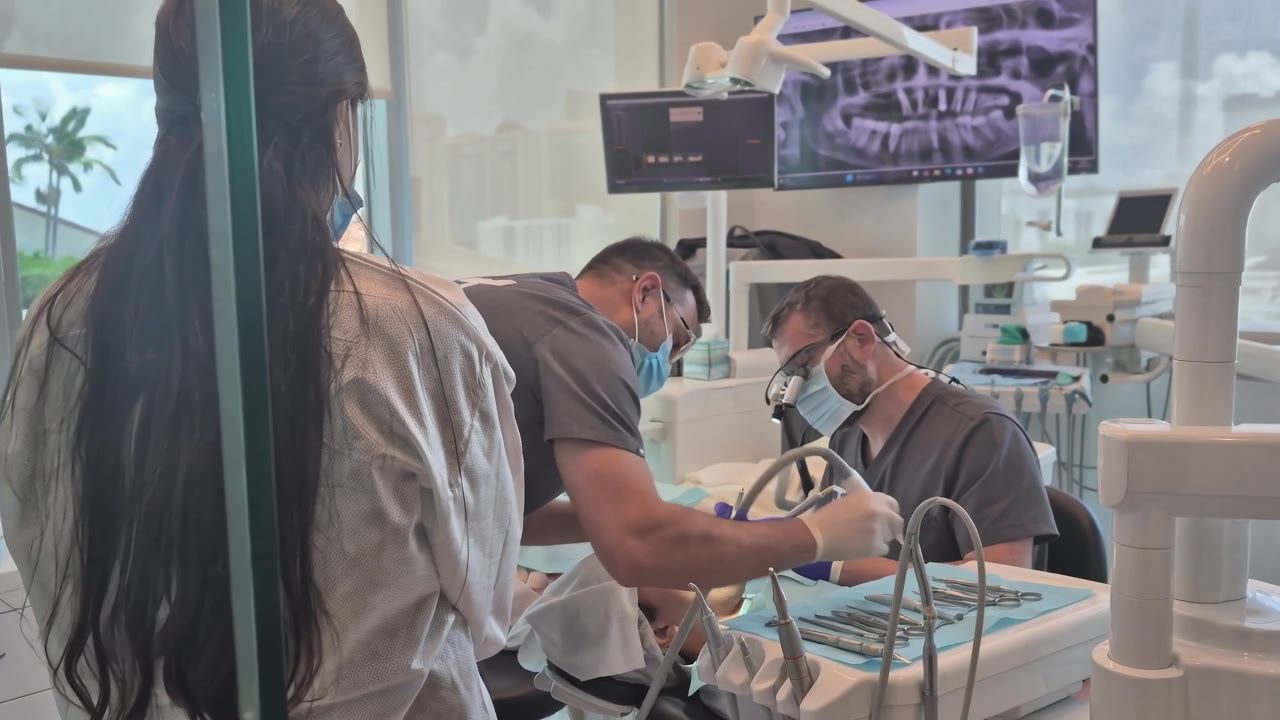
Dr. Baruch Tetri, DDS, is a periodontist (a dentist who specializes in the gums and the bone that hold teeth). Inlays and onlays are prepared and fitted in our office.
An inlay sits inside the tooth between the cusps, where a filling would go. An onlay also covers one or more cusps. Both are made outside the mouth and bonded or cemented to the tooth; ours are hand-made in our own laboratory from feldspathic porcelain. Made outside the mouth, they hold their shape and contacts well in a large cavity, and an onlay can shield a weakened cusp without cutting the whole tooth down for a crown. In a small cavity a filling does just as well.
What happens at the visit
- Diagnosis. We check how much sound tooth is left, whether there is a crack, and whether the nerve is healthy. The size of the defect decides between a filling, an onlay and a crown.
- Preparation. We numb the tooth, lift out the old filling and any decay, and shape only the surfaces the onlay will replace. The margin (the edge where the onlay meets the tooth) is kept on clean enamel wherever we can, because that is where the bond holds. A digital scan goes to the laboratory and a temporary covers the tooth.
- Bonding. The tooth is kept dry, the onlay is tried in, and we check the margin, the contacts and your bite before it is bonded. If the bite feels high we adjust it the same day.

Risks and limits
- Preparation can leave the tooth sensitive; if the nerve was already inflamed it may still need root canal treatment, as with a crown.
- Neither an onlay nor a crown fuses a crack; a crack that runs down the root cannot be fixed, and we say so before treatment.
- An onlay can come loose if saliva contaminates the bond, which is why the dry field matters.
- A margin deep under the gum is hard to bond and hard to clean; if decay runs there, a crown may be the better choice.
- New decay begins at the join between onlay and tooth, so flossing that edge is what keeps it.
Questions patients ask
Onlay or crown?
If the walls of the tooth are sound, an onlay saves them and bonds to enamel. If the tooth is cracked at the base or little remains above the gum, a crown holds better. We explain which case yours is before anything is shaped.
Why not just a bigger filling?
Past a certain size a composite filling built up in the mouth is hard to shape well, shrinks as it sets and leaves a cusp unsupported. An onlay made outside the mouth avoids those problems.
How long does an onlay last?
About as long as a crown, often more than a decade. The bond and the edges are what age; cleaning the join and not chewing ice help.
Does insurance cover an onlay?
Many plans cover it like a crown, some like a filling.
Sources
- ADA: Materials for indirect restorations
- FDI: Repair of restorations
- AAE: Cracked teeth
- Systematic review: Posterior partial-coverage restorations
- Systematic review: Inlays/onlays versus complete crowns
Request a visit
Tetri’s Smile · 16690 Collins Avenue, Suite 701, Sunny Isles Beach, FL 33160