Who this is for
- Bleeding, swollen or receding gums, loose teeth, sensitivity or persistent bad breath that needs a diagnosis rather than a cosmetic cover-up.
- Known bone loss, deep gum pockets, or areas that are still active after a deep cleaning elsewhere.
- An implant, veneer or full-mouth plan that depends on stable, cleanable gum and bone.
What we do at our office
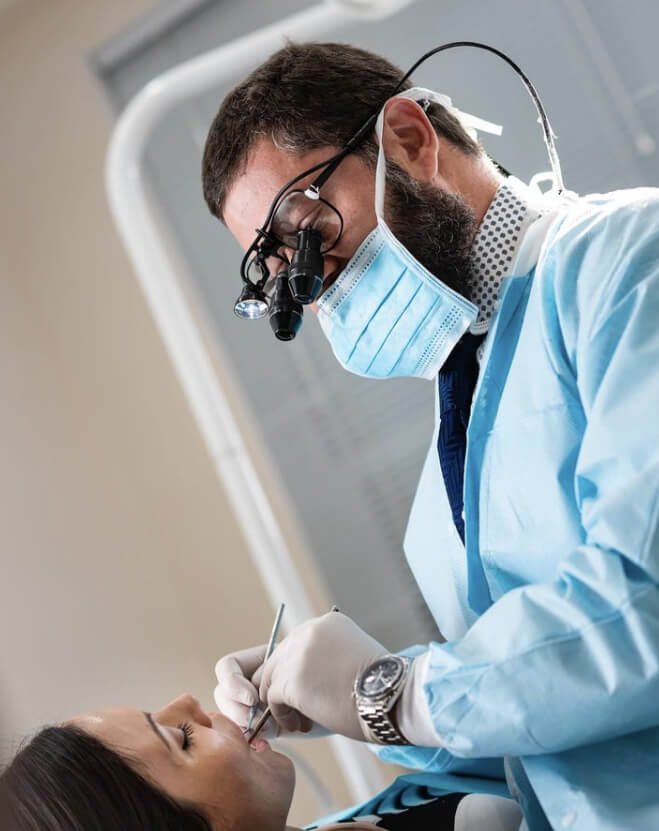
Dr. Tetri examines and treats gum disease himself. Our care runs from a full periodontal examination and deep cleaning (scaling and root planing, the removal of deposits below the gumline) through periodontal surgery: pocket reduction, regenerative procedures for bone defects, gum grafts for recession, and crown lengthening (reshaping the gum, and sometimes the bone, so that more tooth shows or a crown can be fitted). Routine cleanings and a first deep cleaning sit under Everyday care; this page is for the cases that need a periodontist. For surgery we use local anesthesia and, after a medical review, offer sedation options where our permits and team allow.
What happens at the visit
- We measure. A periodontal chart records pocket depths, bleeding, recession and looseness tooth by tooth, alongside your history, your risk factors and the X-rays the findings call for.
- We name the condition. Gingivitis (inflammation without bone loss) and periodontitis (loss of the attachment and bone around the teeth) are different diagnoses. Periodontitis gets a stage, how far it has gone, and a grade, how fast it is moving.
- We control the inflammation first. Home-care coaching, removal of plaque and tartar, and attention to smoking and diabetes. Where periodontitis is present, deep cleaning disrupts the deposits and bacteria around the roots. Antibiotics, antiseptics and lasers are added only when there is a reason.
- We re-measure before any surgery. Sites that have become shallow, non-bleeding and cleanable move into maintenance. Only the sites that stay deep are discussed for surgery.
- We operate only on what remains. Pocket reduction to give access for cleaning, regeneration for selected bone defects, grafting for recession, crown lengthening where a restoration needs it.
- We keep you stable. Supportive periodontal care, maintenance visits spaced to your disease history and risk, typically every three to six months.
Risks and limits
- Deep cleaning and surgery can cause soreness, swelling, bleeding, sensitivity and some gum shrinkage as the inflammation resolves.
- Root coverage for recession and regeneration of lost bone vary by defect and technique; complete coverage or full regeneration is not possible in every case.
- In advanced disease some teeth may still be lost, even with good treatment.
- Removing tissue only to make a tooth look longer is not a diagnosis; we do it only where the gum and bone allow it.
- People who keep their maintenance visits keep more teeth; that is the pattern, not a promise.
- We tell you what is normal after surgery and when to call us.
Questions patients ask
Does treating my gums help my diabetes or my heart?
Treating gum disease is good for your mouth and may help your general health. It is not a treatment for diabetes or heart disease, and we will not tell you it is.
Does deep cleaning hurt?
We numb the area with local anesthesia. Expect tenderness and some sensitivity to cold for a few days afterward.
Do I need surgery?
Not at the first visit. We decide after the first phase of treatment, when we re-measure. Many sites settle without surgery; the ones that stay deep are the ones we discuss.
Will my receded gums grow back?
Not on their own. A gum graft can cover part or all of an exposed root in many cases; how much depends on the shape of the defect and the bone around it. We show you what is realistic for your tooth before you decide.
How often will I need to come back?
After treatment, most patients with periodontitis are seen for maintenance every three to six months. The interval is set to your risk, not to a calendar.
Related under Complex care: Dental implants · Full-mouth rehabilitation · Porcelain veneers.
Sources
- NIDCR: Periodontal (gum) disease
- ADA: Nonsurgical treatment of periodontitis guideline
- AAP/EFP: Periodontitis classification consensus
- EFP S3 guideline: Treatment of stage I–III periodontitis
- Cochrane review: Root-coverage procedures
- Systematic review: Regenerative treatment of intrabony defects