Who this is for
- You have lost a tooth and want to compare a bridge, an implant, a removable partial denture and leaving the gap.
- The teeth next to the gap already have large fillings, crowns or root canals, which changes whether they make good anchors.
- You want a second opinion on a bridge someone else has proposed.
What we do at our office
Dr. Baruch Tetri, DDS, is a periodontist (a dentist who specializes in the gums and the bone that hold teeth). He examines the gap, the neighboring teeth and the bone around them before a design is chosen, because a bridge is only as sound as what carries it. Bridges are planned and fitted in our office. Implants that carry a bridge are placed by Dr. Tetri (/dental-implants).
Leaving the gap is sometimes reasonable; we tell you when it is and what we would watch for.
The designs we compare
- Tooth-supported bridge. Crowns on the teeth either side carry the false tooth. Sensible when those teeth already need crowns; otherwise it cuts healthy enamel to make anchors.
- Resin-bonded bridge. A false tooth with a thin wing bonded to the back of one neighbor. It needs little or no drilling and suits some front-tooth gaps; the wing can come loose.
- Cantilever bridge. The false tooth hangs from one side only. It works in selected small spaces, not across the back teeth.
- Implant-supported bridge. Implants carry the false teeth and the neighbors are left alone. It involves surgery and its own long-term care.
- Removable partial denture. Replaces several teeth without drilling, but it moves, comes out for cleaning and is bulkier. Small one-sided removable partials can be inhaled or swallowed, so we rarely suggest them.
- Closing the space with orthodontics. For some missing front teeth, especially a lateral incisor (the small tooth beside the front two), moving the neighbors can close the gap. When that is an option we say so and go through the orthodontic options with you first, including Invisalign® clear aligners where they fit the case (/orthodontic-treatment/invisalign).
What happens at the visit
- Examination and records. We check the anchor teeth, the bone, your bite and how you clean, and take the X-rays the decision needs. A three-dimensional scan (CBCT) is used for implant planning, not for every bridge.
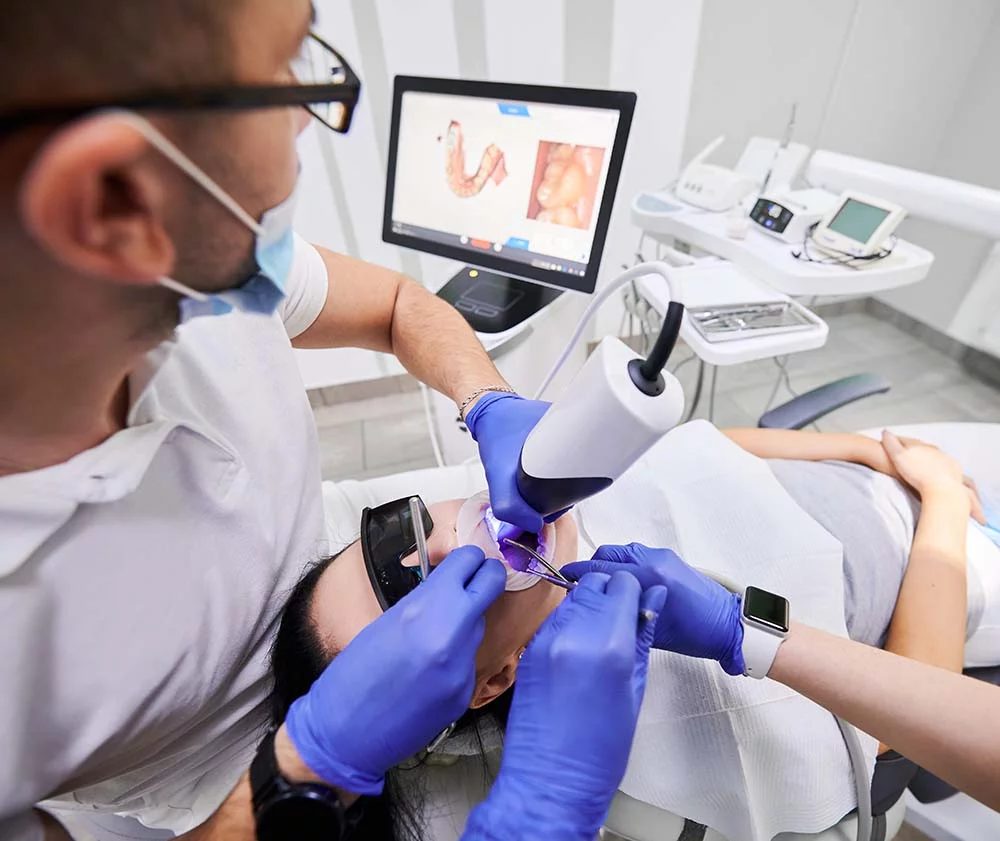
- Preparation. For a tooth-supported bridge we shape the anchor teeth under local anesthesia and take a digital scan. You leave with a temporary bridge.
- Fitting. We check the fit, the contacts, the bite, the look and your speech, and adjust before the bridge is cemented or bonded.
- Maintenance. We show you how to clean under the false tooth with floss threaders or small brushes and check the bridge at each visit.
Risks and limits
- The anchor teeth can become sensitive, and a few later need root canal treatment.
- Decay under a crown edge is the most common reason a bridge fails; cleaning under the false tooth is what prevents it.
- Bonded wings can come loose, porcelain can chip, and a cemented bridge can loosen; call us, because a loose bridge left in place lets decay in.
- An implant can fail to fuse with the bone (integrate) or develop gum disease around it later.
- Every bridge is repaired or remade at some point; we plan for that from the start.
Questions patients ask
Bridge or implant?
An implant leaves the neighbors untouched and cleans like a tooth, but it needs surgery, enough bone and more time. A bridge is quicker and avoids surgery, but uses the neighbors. If those teeth are sound we usually lean toward an implant; if they already need crowns, a bridge can be the better choice.
How long does a bridge last?
Often ten years or more, and some much longer. It depends more on the health of the anchor teeth and on daily cleaning than on the material.
Does it hurt?
The preparation is done under local anesthesia; expect some sensitivity for a few days with the temporary.
Sources
- ADA MouthHealthy: Bridges
- ACP: Posterior Single Tooth Replacement
- Systematic review: Resin-bonded fixed dental prostheses
- Systematic review: Orthodontic space closure versus prosthetic replacement
- Scoping review: Implant-supported fixed dental prosthesis complications
Request a visit
Tetri’s Smile · 16690 Collins Avenue, Suite 701, Sunny Isles Beach, FL 33160