Who this is for
- Your teeth are worn, cracked or missing in several places, or fillings and crowns keep failing.
- You need work from more than one specialty and want one person to run the plan.
- You have been told you need everything done and want to know what order it should happen in.
What we do at our office
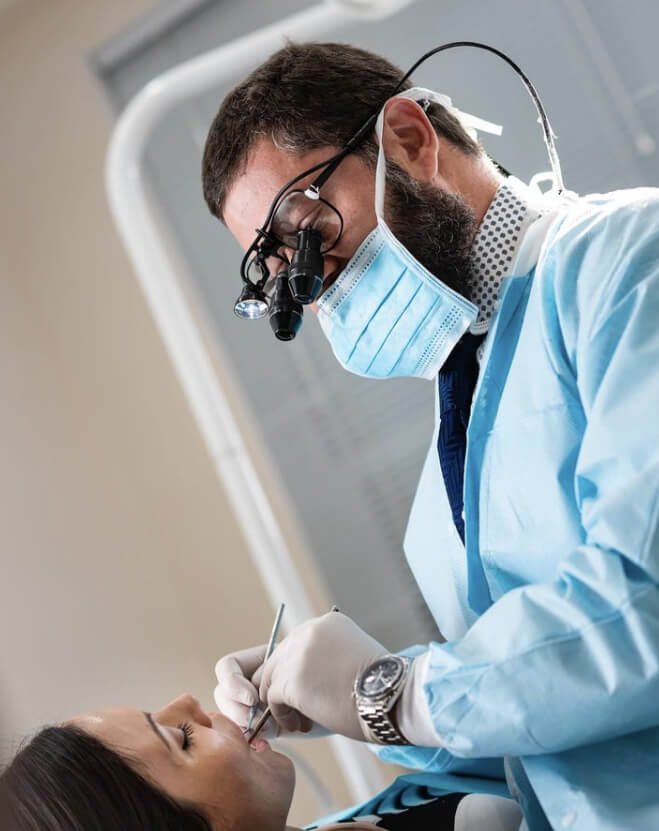
Dr. Baruch Tetri, DDS, is a periodontist (a dentist with specialty training in gums, bone and implants). He earned his DDS at NYU College of Dentistry in 2006, completed his Certificate in Periodontics in 2009, and is a Diplomate of the American Board of Periodontology. In a rehabilitation he runs the plan and does the gum treatment, the implants and the surgery himself. Crowns, bridges and veneers are designed in our digital laboratory. Root canals are done in our office. When teeth need moving first, we plan it with Invisalign® clear aligners where they fit the case.
Full-mouth is not full-arch. Full-arch means replacing every tooth in one jaw with an implant bridge; full-mouth rehabilitation usually keeps teeth and rebuilds around them, across both jaws. The diagnosis decides which you need, and it is rarely a reason to remove every tooth.
The order is the plan. Disease is controlled first, then teeth are kept, restored or replaced, then the final work is made. Several steps can share one visit when it is safe; the diagnosis before, the healing between and the final teeth cannot be hurried. Long restorative visits can be done with sedation after a medical review, where our permits and team allow.
What happens at the visit
- Diagnosis. We check the gums and the outlook for every tooth, and we look at old work, wear and what is missing. Photographs and scans go with the notes, and we start with what bothers you most.
- The plan. We compare the reasonable paths and say what can be kept and what has to go. You get it in writing, with the stages, the alternatives and a timeline in months.
- A trial. Where the shape, the speech or the bite will change, we try the proposal first with a mock-up (a trial version of the new teeth placed over your own) or temporary teeth. Temporaries can be adjusted; final ceramic cannot.
- Stages. Gum treatment and extractions come first, then grafting or implants, then tooth movement if planned. Each stage heals before the next begins.
- Final work and upkeep. Crowns, bridges and implant teeth are made once the mouth is stable. Then come checkups and cleanings, with repairs planned for rather than hoped against.
Risks and limits
- A rehabilitation runs for months, sometimes more than a year. Travel does not make biology move faster.
- Teeth that are kept can still fail later and need root canals, crowns or removal.
- Temporaries chip and come loose; we fix them, but plan on extra visits.
- Changing how the teeth meet can take weeks for the muscles and joints to settle.
- Ceramic, resin, screws and implants all wear and can break; the plan says how each would be repaired.
- Findings during surgery can change the order or the timing.
Questions patients ask
Can it all be done in one day?
Several coordinated steps can happen in one visit: extractions, implants and a fixed temporary, for example. The diagnosis before it, the healing after it and the final teeth cannot. A finished mouth in a day describes the temporary.
Will I be without teeth at any point?
The plan is built so you leave each stage with teeth, temporary or final. Where surgery makes a fixed temporary unsafe, a removable one covers the gap.
What does it cost?
It depends on how many teeth are kept, how many are replaced and what they are made of.
Do I have to do everything at once?
No. Disease control comes first and should not wait; the rest can be staged, and the plan says what can safely be deferred.
Sources
- American College of Prosthodontists: Full-mouth reconstruction
- ITI consensus: Complete-arch implant planning
- ITI consensus: Loading protocols for fixed prostheses in edentulous jaws (jaws with no teeth)
- Systematic review: Immediate versus early or conventional implant loading
Request a visit
[Request a visit](/book) · Call 786-320-5445