Who this is for
- You have been told there is not enough bone for an implant where the tooth needs to go.
- You are about to lose a tooth and want to keep the option of an implant later.
- You want a second opinion: a graft, a shorter implant, a bridge, a removable tooth or leaving the gap.
What we do at our office
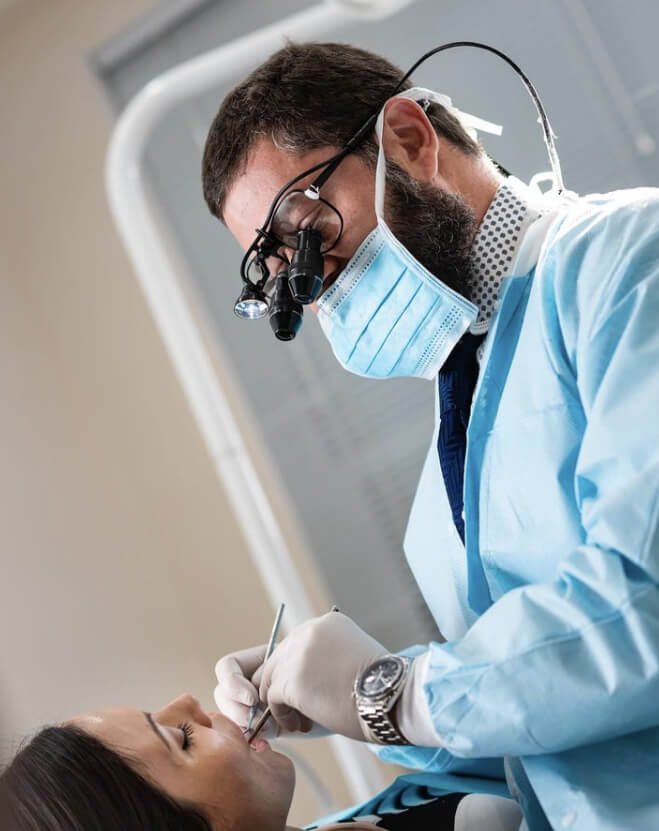
Dr. Baruch Tetri, DDS, is a periodontist. He earned his DDS at NYU College of Dentistry in 2006, completed his Certificate in Periodontics in 2009, and is a Diplomate of the American Board of Periodontology.
There are two kinds of graft. Ridge preservation is done the day a tooth is removed: the socket is filled with graft material so the bone keeps its shape. Ridge augmentation rebuilds a ridge that has already shrunk, in width (a horizontal defect) or height (a vertical defect); vertical defects are harder and slower.
Graft material can be your own bone, donor human bone, bovine (cow) bone or a synthetic mineral, usually covered by a membrane (a thin collagen sheet that protects the graft while it heals). We explain where each comes from and what it costs, and you choose.
In some sites the implant is placed the same day as the graft; in others we wait for it to mature, and Dr. Tetri tells you which before you decide. Active gum disease is treated first; a graft placed into infected tissue does not hold. For longer surgeries, IV sedation is available after a medical review, where our permits and team allow.
What happens at the visit
- Consultation. Dr. Tetri examines the site, reviews your health and medicines, and takes a CBCT scan (a three-dimensional dental X-ray) when the question needs one.
- A written plan. What is missing, which approach and material, whether the implant goes in at the same time, the alternatives, and the front desk’s written estimate.
- Surgery day. The graft is placed under local anesthesia, with sedation if we planned it; you go home the same day with a care sheet.
- The first week. Swelling and soreness peak on day two or three; soft food and over-the-counter pain medicine are enough for most patients, and we see you for a check in the first week or two.
- Healing. Usually three to six months before the implant, longer for larger or vertical grafts; we check the healed site clinically and on an X-ray first.
- Implant, tooth, maintenance. The implant is placed, the crown follows once it has bonded to the bone, and we check the implant at your regular visits.
Risks and limits
- Pain, swelling and bruising for several days; if we take bone from elsewhere in your mouth, that site is sore too.
- Infection, early wound opening or an exposed membrane are less common and usually managed in the office.
- Part of every graft is reabsorbed as it heals; occasionally too little remains and a second, smaller graft is needed.
- Nerves and the sinus are mapped on the scan first; a numb patch on the lip or chin afterward is uncommon and usually fades.
- Smoking, uncontrolled diabetes and untreated gum disease lower the chance that a graft holds; we address them before surgery.
- A graft makes an implant possible; it does not promise that the implant will succeed.
Questions patients ask
Do I always need a graft before an implant?
No. Many implants are placed without one; we suggest a graft only when the scan shows the implant would otherwise be too short, too narrow or badly placed.
How long before I can have the implant?
Usually three to six months after a ridge preservation or small horizontal graft, often six to nine after a larger or vertical one. Dr. Tetri confirms the timing from the healed site, not the calendar.
Sources
Request a visit
Dr. Tetri sees you at our Sunny Isles Beach office, 16690 Collins Avenue, Suite 701, Sunny Isles Beach, FL 33160.